{whitepaper}
{whitepaper}
{whitepaper}
{positioning pakistan's}
{ai & web3 economy}_ _ _
{positioning pakistan's}
{ai & web3 economy}_ _ _
{positioning pakistan's}
{ai & web3 economy}_ _ _
|for productive growth.
|for productive growth.
|for productive growth.
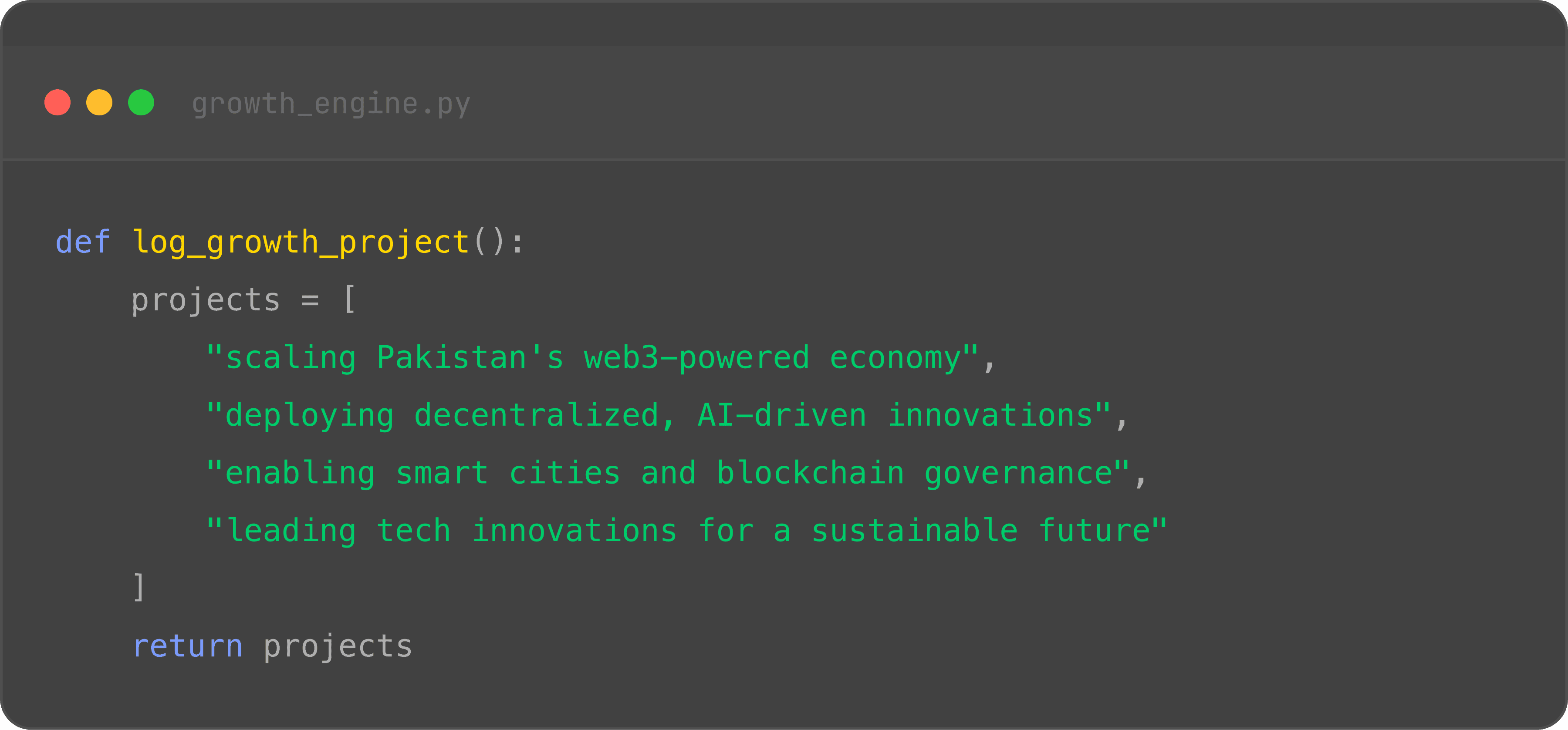
{not here to consume}
{here to innovate}___|
from adoption to {agency} by
from adoption to {agency} by
from adoption to {agency} by

// pakistan.ai_web3_report
// mode: analysis → clarity
region = "pakistan"
population = "240m+"
time_horizon = "2025–2030"
north_star = "productive growth"
signals = {
talent_pool: "under-mobilized",
startup_density: "accelerating",
regulation_state: "evolving"
}
thesis = [
"ai ↑ productivity",
"web3 ↑ coordination",
"execution > narratives"
]
// pakistan.ai_web3_report
// mode: analysis → clarity
// pakistan.ai_web3_report
// mode: analysis → clarity
region = "pakistan"
population = "240m+"
time_horizon = "2025–2030"
north_star = "productive growth"
region = "pakistan"
population = "240m+"
time_horizon = "2025–2030"
north_star = "productive growth"
signals = {
talent_pool: "under-mobilized",
startup_density: "accelerating",
regulation_state: "evolving"
}
signals = {
talent_pool: "under-mobilized",
startup_density: "accelerating",
regulation_state: "evolving"
}
thesis = [
"ai ↑ productivity",
"web3 ↑ coordination",
"execution > narratives"
]
thesis = [
"ai ↑ productivity",
"web3 ↑ coordination",
"execution > narratives"
]
2026
2026
{positioning pakistan's}
{ai & web3 economy}__
|for productive growth.
{positioning pakistan's}
{ai & web3 economy}__
|for productive growth.
{positioning pakistan's}
{ai & web3 economy}__
|for productive growth.
Pakistan stands at a pivotal moment in its digital journey today. With an estimated 40 million crypto users, one of the youngest digital populations in the world, and rapidly growing exposure to emerging technologies, the country has demonstrated extraordinary adoption velocity. Yet adoption alone does not translate into economic strength. Without deliberate policy direction, institutional readiness, and capacity-building, high participation risks remaining highly informal, consumption-driven, and economically extractive.
Global experience increasingly shows that countries that fail to distinguish between usage and value creation face growing regulatory complexity, talent leakage, and systemic risk. Conversely, those that move early to establish clear governance frameworks, education pipelines, and controlled experimentation environments are better positioned to convert emerging technologies into productivity, exports, and employment.
Pakistan stands at a pivotal moment in its digital journey today. With an estimated 40 million crypto users, one of the youngest digital populations in the world, and rapidly growing exposure to emerging technologies, the country has demonstrated extraordinary adoption velocity. Yet adoption alone does not translate into economic strength. Without deliberate policy direction, institutional readiness, and capacity-building, high participation risks remaining highly informal, consumption-driven, and economically extractive.
Global experience increasingly shows that countries that fail to distinguish between usage and value creation face growing regulatory complexity, talent leakage, and systemic risk. Conversely, those that move early to establish clear governance frameworks, education pipelines, and controlled experimentation environments are better positioned to convert emerging technologies into productivity, exports, and employment.
Pakistan stands at a pivotal moment in its digital journey today. With an estimated 40 million crypto users, one of the youngest digital populations in the world, and rapidly growing exposure to emerging technologies, the country has demonstrated extraordinary adoption velocity. Yet adoption alone does not translate into economic strength. Without deliberate policy direction, institutional readiness, and capacity-building, high participation risks remaining highly informal, consumption-driven, and economically extractive.
Global experience increasingly shows that countries that fail to distinguish between usage and value creation face growing regulatory complexity, talent leakage, and systemic risk. Conversely, those that move early to establish clear governance frameworks, education pipelines, and controlled experimentation environments are better positioned to convert emerging technologies into productivity, exports, and employment.
Executive Summary
This white paper consolidates insights from a cross-sector policy roundtable involving government representatives, industry leaders, financial institutions, educators, and ecosystem builders. It identifies structural
gaps in regulation, education, and ecosystem coordination that are preventing Pakistan from fully leveraging AI and Web3 technologies, and reached a shared assessment:
This white paper consolidates insights from a cross-sector policy roundtable involving government representatives, industry leaders, financial institutions, educators, and ecosystem builders. It identifies structural
gaps in regulation, education, and ecosystem coordination that are preventing Pakistan from fully leveraging AI and Web3 technologies, and reached a shared assessment:
This white paper consolidates insights from a cross-sector policy roundtable involving government representatives, industry leaders, financial institutions, educators, and ecosystem builders. It identifies structural
gaps in regulation, education, and ecosystem coordination that are preventing Pakistan from fully leveraging AI and Web3 technologies, and reached a shared assessment:
Pakistan is no longer at the stage of debating whether AI and Web3 matter — the challenge now is how they are governed, enabled, and aligned with national priorities.
Pakistan is no longer at the stage of debating whether AI and Web3 matter — the challenge now is how they are governed, enabled, and aligned with national priorities.
The paper proposes a layered policy approach that distinguishes between blockchain infrastructure, crypto assets, AI capabilities, and Web3 applications, enabling targeted regulation rather than blanket restriction.
It further outlines immediate, low-risk opportunities - including blockchain-based remittances and verification systems - alongside medium- and long-term interventions in education, talent development, and industry enablement.
The recommendations presented are intended to serve as a practical guide for policymakers, regulators, and institutional stakeholders seeking to transition Pakistan from high adoption to high value creation.
The paper proposes a layered policy approach that distinguishes between blockchain infrastructure, crypto assets, AI capabilities, and Web3 applications, enabling targeted regulation rather than blanket restriction.
It further outlines immediate, low-risk opportunities - including blockchain-based remittances and verification systems - alongside medium- and long-term interventions in education, talent development, and industry enablement.
The recommendations presented are intended to serve as a practical guide for policymakers, regulators, and institutional stakeholders seeking to transition Pakistan from high adoption to high value creation.
The paper proposes a layered policy approach that distinguishes between blockchain infrastructure, crypto assets, AI capabilities, and Web3 applications, enabling targeted regulation rather than blanket restriction.
It further outlines immediate, low-risk opportunities - including blockchain-based remittances and verification systems - alongside medium- and long-term interventions in education, talent development, and industry enablement.
The recommendations presented are intended to serve as a practical guide for policymakers, regulators, and institutional stakeholders seeking to transition Pakistan from high adoption to high value creation.

Why AI & Web3 Matter
for Pakistan — Now?
Why AI & Web3 Matter for Pakistan — Now?
Why AI & Web3 Matter
for Pakistan — Now?
Pakistan’s demographic profile presents a unique opportunity. A young, digitally active population combined with rising global demand for AI and Web3 talent positions the country to participate meaningfully in the next phase of the global digital economy. However, without deliberate intervention, Pakistan risks remaining a net consumer of technology rather than a producer of digital value.
Pakistan’s demographic profile presents a unique opportunity. A young, digitally active population combined with rising global demand for AI and Web3 talent positions the country to participate meaningfully in the next phase of the global digital economy. However, without deliberate intervention, Pakistan risks remaining a net consumer of technology rather than a producer of digital value.
Pakistan’s demographic profile presents a unique opportunity. A young, digitally active population combined with rising global demand for AI and Web3 talent positions the country to participate meaningfully in the next phase of the global digital economy. However, without deliberate intervention, Pakistan risks remaining a net consumer of technology rather than a producer of digital value.
Current patterns show high engagement driven by speculative narratives, influencer-led content, and informal participation. While this reflects interest and appetite, it also exposes users to financial risk, regulatory uncertainty, and limited upward mobility. The absence of structured policy direction, curriculum alignment, and compliant experimentation frameworks has resulted in fragmented growth.
Current patterns show high engagement driven by speculative narratives, influencer-led content, and informal participation. While this reflects interest and appetite, it also exposes users to financial risk, regulatory uncertainty, and limited upward mobility. The absence of structured policy direction, curriculum alignment, and compliant experimentation frameworks has resulted in fragmented growth.
Current patterns show high engagement driven by speculative narratives, influencer-led content, and informal participation. While this reflects interest and appetite, it also exposes users to financial risk, regulatory uncertainty, and limited upward mobility. The absence of structured policy direction, curriculum alignment, and compliant experimentation frameworks has resulted in fragmented growth.
!
The cost of inaction is not neutrality - it is missed opportunity, informalization, and loss of competitiveness.
The cost of inaction is not neutrality - it is missed opportunity, informalization, and loss of competitiveness.
// opportunity vectors
opportunities = [
"ai-led services exports",
"web3-backed digital id",
"public service automation",
"fintech trust layers",
"global talent participation"
]
// opportunity vectors
opportunities = [
"ai-led services exports",
"web3-backed digital id",
"public service automation",
"fintech trust layers",
"global talent participation"
]
// structural constraints
constraints = [
"policy fragmentation",
"low compute access",
"weak data governance",
"skills mismatch",
"short-term loops"
]
// structural constraints
constraints = [
"policy fragmentation",
"low compute access",
"weak data governance",
"skills mismatch",
"short-term loops"
]
rule = "build systems, not hype"
metric = "output > narrative"
rule = "build systems, not hype"
metric = "output > narrative"
01.
01.

National Context & Strategic Imperative.
National Context & Strategic Imperative.
National Context & Strategic Imperative.
Pakistan’s engagement with emerging technologies has reached a scale where policy neutrality is no longer neutral. With an estimated 40 million crypto users, the country demonstrates one of the highest adoption rates globally. However, this participation remains largely informal, retail-led, and consumption-oriented, with limited translation into domestic productivity, exports, or institutional value.
Pakistan’s engagement with emerging technologies has reached a scale where policy neutrality is no longer neutral. With an estimated 40 million crypto users, the country demonstrates one of the highest adoption rates globally. However, this participation remains largely informal, retail-led, and consumption-oriented, with limited translation into domestic productivity, exports, or institutional value.
As one participant noted during the roundtable:
As one participant noted during the roundtable:
Adoption has already happened. The policy question now is whether we govern it or allow it to continue without structure.
Adoption has already happened. The policy question now is whether we govern it or allow it to continue without structure.
Adoption has already happened. The policy question now is whether we govern it or allow it to continue without structure.
— Roundtable participant
"
International experience suggests that high adoption without institutional frameworks leads to:
International experience suggests that high adoption without institutional frameworks leads to:
•
Increased regulatory burden over time
Increased regulatory burden over time
•
Talent outflows rather than domestic capability
Talent outflows rather than domestic capability
•
Greater consumer risk and misinformation
Greater consumer risk and misinformation
•
Reduced confidence among compliant enterprises
Reduced confidence among compliant enterprises
Conversely, countries that establish early clarity, layered governance, and controlled experimentation are better positioned to convert emerging technologies into economic opportunity.
Conversely, countries that establish early clarity, layered governance, and controlled experimentation are better positioned to convert emerging technologies into economic opportunity.
// assessment signals
// assessment signals
adoption = "high"
depth = "shallow"
builders = "few"
graduates = "underprepared"
adoption = "high"
depth = "shallow"
builders = "few"
graduates = "underprepared"
print("> users at scale")
print("> systems: not yet")
print("> gap = risk")
print("> users at scale")
print("> systems: not yet")
print("> gap = risk")
02.
02.
Current State Assessment: Key Signals from the Ecosystem.
Current State Assessment: Key Signals from the Ecosystem.
Current State Assessment: Key Signals from the Ecosystem.
2.1 — Adoption without productive depth
Roundtable participants consistently highlighted a structural imbalance in Pakistan’s digital economy. While user participation is high, builder activity, product development, and IP creation remain limited.
Key signals include:
Roundtable participants consistently highlighted a structural imbalance in Pakistan’s digital economy. While user participation is high, builder activity, product development, and IP creation remain limited.
Key signals include:
⟐
Crypto and Web3 engagement
driven primarily by individual
users
Crypto and Web3 engagement driven primarily by individual users
Crypto and Web3 engagement
driven primarily by individual
users
⟐
Limited presence of domestic
blockchain or AI product
companies
Limited presence of domestic blockchain or AI product companies
Limited presence of domestic
blockchain or AI product
companies
⟐
Low participation of regulated
institutions in experimentation
Low participation of regulated institutions in experimentation
Low participation of regulated
institutions in experimentation
One industry participant summarised this challenge as follows:
One industry participant summarised this challenge as follows:
"
“We have users at scale, but not systems at scale. That gap increases risk rather than reducing it.
“We have users at scale, but not systems at scale. That gap increases risk rather than reducing it.
— Roundtable participant
From a governance perspective, this imbalance creates regulatory complexity without corresponding economic upside.
From a governance perspective, this imbalance creates regulatory complexity without corresponding economic upside.
2.2 — Talent supply and education readiness
Despite a large IT graduate base, ecosystem inputs indicate that less than 20% of graduates have meaningful exposure to blockchain technologies, and even fewer possess applied experience in AI- enabled or Web3-based systems.
Despite a large IT graduate base, ecosystem inputs indicate that less than 20% of graduates have meaningful exposure to blockchain technologies, and even fewer possess applied experience in AI- enabled or Web3-based systems.
•
Outdated university curricula
Outdated university curricula
•
Limited faculty capacity in emerging technologies
Limited faculty capacity in emerging technologies
•
Weak institutional feedback loops between industry and academia
Weak institutional feedback loops between industry and academia
•
Absence of structured mid-degree interventions
Absence of structured mid-degree interventions
Graduates are leaving institutions with credentials, but without readiness for emerging technology roles.
Graduates are leaving institutions with credentials, but without readiness for emerging technology roles.
"
This gap limits employability outcomes and constrains the development of a domestic builder economy.
This gap limits employability outcomes and constrains the development of a domestic builder economy.
2.3 — Regulatory and institutional readiness
Current regulatory approaches often conflate distinct technology layers, resulting in ambiguity and inconsistent enforcement.
Current regulatory approaches often conflate distinct technology layers, resulting in ambiguity and inconsistent enforcement.
•
Lack of distinction between blockchain infrastructure and crypto assets
Lack of distinction between blockchain infrastructure and crypto assets
•
Misalignment between commercial regulations and penal code provisions
Misalignment between commercial regulations and penal code provisions
•
Low technical literacy within decision-making processes
Low technical literacy within decision-making processes
•
Risk-averse responses driven by uncertainty rather than evidence
Risk-averse responses driven by uncertainty rather than evidence
"
The absence of clarity makes compliance harder, not easier — even for institutions willing to engage responsibly.
The absence of clarity makes compliance harder, not easier — even for institutions willing to engage responsibly.
This environment discourages experimentation by banks, enterprises, and global platforms operating within compliance boundaries.
This environment discourages experimentation by banks, enterprises, and global platforms operating within compliance boundaries.
03.
03.
Technology Layering Framework for Policy Clarity.
Technology Layering Framework for Policy Clarity.
Technology Layering Framework for Policy Clarity.
Layer 1
Blockchain Infrastructure
Blockchain Infrastructure
Distributed ledgers, Registries, Ownership records, Verification
systems.
Distributed ledgers, Registries, Ownership records, Verification systems.
Distributed ledgers, Registries, Ownership records, Verification systems.
Policy focus:
Infrastructure governance
Infrastructure governance
Infrastructure governance
Layer 2
Crypto Assets
Crypto Assets
Tokens, Exchanges, Custody, Trading platforms.
Tokens, Exchanges, Custody, Trading platforms.
Tokens, Exchanges, Custody, Trading platforms.
Policy focus:
Financial regulation, consumer protection, AML/CFT
Financial regulation, consumer protection, AML/CFT
Financial regulation, consumer protection, AML/CFT
Layer 3
Artificial Intelligence
Artificial Intelligence
Automation, Analytics, Decision-support systems.
Automation, Analytics, Decision-support systems.
Automation, Analytics, Decision-support systems.
Policy focus:
Productivity enablement, ethical safeguards, data integrity
Productivity enablement, ethical safeguards, data integrity
Productivity enablement, ethical safeguards, data integrity
Layer 4
Web3 Applications
Web3 Applications
Gaming, Digital platforms, Decentralised applications.
Gaming, Digital platforms, Decentralised applications.
Gaming, Digital platforms, Decentralised applications.
Policy focus:
Innovation enablement under compliance standards
Innovation enablement under compliance standards
Innovation enablement under compliance standards
// priority areas
// risk: mitigated
// impact: high
pilots = [
"blockchain remittances",
"banking infrastructure",
"degree verification"
]
for p in pilots:
print(f"deploying: {p}")
print("> status: ready")
04.
04.
Priority opportunity areas
(Risk-mitigated).
Priority opportunity areas
(Risk-mitigated).
Priority opportunity areas
(Risk-mitigated).
4.1
Inward Remittances
Inward Remittances
Blockchain-based inward remittances were identified as a low-risk, high-impact pilot opportunity.
Blockchain-based inward remittances were identified as a low-risk, high-impact pilot opportunity.
Potential benefits include:
Potential benefits include:
•
Reduced transaction costs
Reduced transaction costs
•
Improved transparency and traceability
Improved transparency and traceability
•
Faster settlement timelines
Faster settlement timelines
Participants noted that minimum viable pilots could be deployed within weeks, provided regulatory coordination and sandbox mechanisms are enabled.
Participants noted that minimum viable pilots could be deployed within weeks, provided regulatory coordination and sandbox mechanisms are enabled.
"
Remittances are a practical entry point — they allow learning without systemic exposure.
4.2
Banking and financial infrastructure
Banking and financial infrastructure
Banks currently face challenges related to custody, compliance interpretation, and integration pathways. However, participants emphasised these as implementation challenges, not structural barriers.
Banks currently face challenges related to custody, compliance interpretation, and integration pathways. However, participants emphasised these as implementation challenges, not structural barriers.
Policy-enabling measures include:
Policy-enabling measures include:
•
Regulatory sandbox participation
Regulatory sandbox participation
•
Embedded compliance within infrastructure
Embedded compliance within infrastructure
•
Phased institutional experimentation
Phased institutional experimentation
This approach supports innovation while maintaining financial stability.As one academic-industry participant noted:
This approach supports innovation while maintaining financial stability.As one academic-industry participant noted:
4.3
Public sector and verification systems
Public sector and verification systems
Blockchain-based degree verification emerged as a non-financial, low-risk application with immediate governance value.
Blockchain-based degree verification emerged as a non-financial, low-risk application with immediate governance value.
Such systems:
Such systems:
•
Reduce fraud
Reduce fraud
•
Improve trust and transparency
Improve trust and transparency
•
Strengthen institutional credibility
Strengthen institutional credibility
This model can be extended to credentials, registries, and public records over time.
This model can be extended to credentials, registries, and public records over time.
05.
05.
Awareness, Public Risk, and Information Integrity.
Awareness, Public Risk, and Information Integrity.
Awareness, Public Risk, and Information Integrity.

Track A
Government-led
Government-led
•
Foundational literacy on AI and blockchain
Foundational literacy on AI and blockchain
•
Focus on understanding and risk awareness
Focus on understanding and risk awareness
Track B
Industry-led
Industry-led
•
Specialised training for graduates, developers, and builders
Specialised training for graduates, developers, and builders
Specialised training for graduates, developers, & builders
•
Builder-centric skill development
Builder-centric skill development
Clear guidance on influencer-led financial content can further protect consumers and improve trust.
Clear guidance on influencer-led financial content can further protect consumers and improve trust.
// policy framework
// mode: recommendations
rule = "build systems, not hype"
metric = "output > narrative"
print("> status: mapped")
print("> opportunity: identified")
print("> next: execute")
06.
06.

Policy Recommendations Framework.
Policy Recommendations Framework.
Policy Recommendations Framework.
Regulatory Alignment
Regulatory Alignment
Regulatory Alignment
→
Adopt layered regulation
Adopt layered regulation
→
Align commercial and penal frameworks
Align commercial and penal frameworks
→
Enable sandbox mechanisms
Enable sandbox mechanisms
Education & Capacity
Education & Capacity
Education & Capacity
→
Minimum blockchain & AI course requirements
Minimum blockchain & AI course requirements
→
Faculty upskilling at 5th–6th semester
Faculty upskilling at 5th–6th semester
→
Structured industry-academia coordination
Structured industry-academia coordination
Industry Enablement
Industry Enablement
Industry Enablement
→
Encourage global platform subsidiaries
Encourage global platform subsidiaries
→
Formalise industry training consortia
Formalise industry training consortia
→
Centralise reporting through industry bodies
Centralise reporting through industry bodies
Governance & Coordination
Governance & Coordination
Governance & Coordination
→
Cross-ministry coordination
Cross-ministry coordination
→
Defined KPIs and accountability
Defined KPIs and accountability
→
Periodic ecosystem assessments
Periodic ecosystem assessments
// future outlook
// from adoption → stewardship
outcomes = [
"informal → productive",
"risk → innovation",
"talent export → build",
"participant → leader"
]
print("> by design, not default")
07.
07.
Future Outlook: From Adoption to Stewardship.
Future Outlook: From Adoption to Stewardship.
Future Outlook: From Adoption to Stewardship.
Pakistan's position in the AI and Web3 landscape is no longer theoretical. Adoption has already created scale; the next phase requires stewardship.
Pakistan's position in the AI and Web3 landscape is no longer theoretical. Adoption has already created scale; the next phase requires stewardship.
With coordinated policy direction, phased implementation, and institutional capacity-building, Pakistan can:
With coordinated policy direction, phased implementation, and institutional capacity-building, Pakistan can:
→
Convert informal participation into productive engagement
Convert informal participation into productive engagement
→
Reduce systemic risk while enabling innovation
Reduce systemic risk while enabling innovation
→
Build domestic capability rather than exporting talent
Build domestic capability rather than exporting talent
→
Position itself as a responsible participant in the global digital economy
Position itself as a responsible participant in the global digital economy
As one participant concluded:
As one participant concluded:
"
The question is not whether Pakistan will engage with these technologies — it already has. The question is whether it will do so by design.
This policy framework is intended to support that design.
This policy framework is intended to support that design.
08.
Conclusion
Conclusion
Conclusion
Pakistan's current engagement with AI and Web3 reflects a strong interest but limited institutional depth. With coordinated policy direction, phased implementation, and capacity-led regulation, the country can transition from adoption-driven participation to structured, productive integration within the global digital economy.
Pakistan's current engagement with AI and Web3 reflects a strong interest but limited institutional depth. With coordinated policy direction, phased implementation, and capacity-led regulation, the country can transition from adoption-driven participation to structured, productive integration within the global digital economy.
Acknowledgements
Acknowledgements
Acknowledgements
This paper is the result of a rigorous cross-sector collaboration. We extend our deepest gratitude to the government representatives, industry leaders, financial institutions, and educators who participated in the policy roundtable. Their diverse perspectives were instrumental in identifying the structural gaps and high-value opportunities within Pakistan’s AI and Web3 landscape.
This paper is the result of a rigorous cross-sector collaboration. We extend our deepest gratitude to the government representatives, industry leaders, financial institutions, and educators who participated in the policy roundtable. Their diverse perspectives were instrumental in identifying the structural gaps and high-value opportunities within Pakistan’s AI and Web3 landscape.
Special thanks are due to the ecosystem builders whose ground-level insights helped bridge the gap between technical adoption and policy readiness. It is our hope that this document serves as a catalyst for the institutional alignment necessary to turn Pakistan’s digital potential into a pillar of national economic growth.
Special thanks are due to the ecosystem builders whose ground-level insights helped bridge the gap between technical adoption and policy readiness. It is our hope that this document serves as a catalyst for the institutional alignment necessary to turn Pakistan’s digital potential into a pillar of national economic growth.
[We thank & appreciate the contributors & participants]
[We thank & appreciate the contributors & participants]
[We thank & appreciate the contributors & participants]
[Contributors & Participants]
[Contributors & Participants]
Saad Ghufran Siddiqui
(Moderator)
Taimor Khalid
Osman Nasir
Bilal Ahsan
Muhammad Hilal
Meiraj Haq
Mariam Saleem
Rana Aitsam
Zeeshan Ahmad
Khubab Naeem
Rafay Niazi
Muhammad Murtaza Khan
Talha Bin Afzal
Shayan Yar
Ahmad Saeed
Asfandyar Khan Arzani
Ali Zain
Sheikh Abdul Qadir
Owais Barlas
[Author]
[Author]
Usra Murtaza
[Reviewed by]
[Reviewed by]
Usman Fiaz
Syed Bilal Wasti

Build or alt+f4.
serious about building?
we don’t have all the answers. but we’ll help you ask better questions and act on them.
stay in loop
serious about building?
we don’t have all the answers. but we’ll help you ask better questions and act on them.
stay in loop

Build or alt+f4.
serious about building?
we don’t have all the answers. but we’ll help you ask better questions and act on them.
stay in loop